Find the perfect size and the right model.
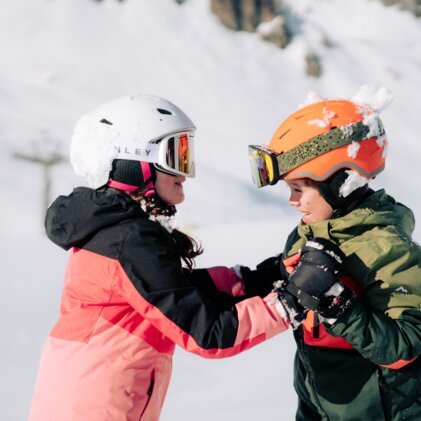
When skiing with children, safety comes first. The be-all and end-all: a ski helmet that fits properly. In addition to the right size, easy handling of the adjustment system and fastening as well as a low weight is important. If the design is also right, the fun on the slopes is twice as great.
Why ski helmets for kids are an important protective piece of equipment
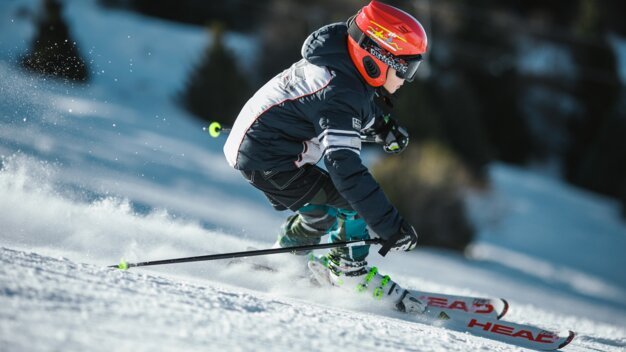
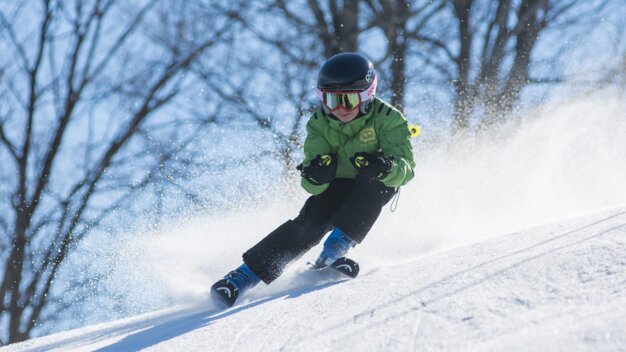
A ski helmet for children is not just a nice accessory, but a vital protective equipment. They have a higher risk of falling than adults and their heads are much more sensitive to injuries. A suitable helmet in the right size protects against:
- Serious head injuries from falls
- Cold and wind on the slopes
- UV radiation (especially models with visors)
The decisive factor is: Only a ski helmet that fits perfectly offers reliable safety in the event of a fall. Use the rental option at INTERSPORT Rent and make sure that your children are always optimally protected when conquering the slopes. Choose the perfect equipment for your skiing adventures from our wide range of products.
Fit and correct size of kid’s ski helmets: How to find the right model
Size is the most important factor when choosing a helmet. Especially when it comes to kids ski helmets, where safety is a priority and the perfect fit is essential.
However, the shape and size of a child's head changes constantly in the first few years of life. As a result, many parents opt for a larger model to save money and allow their child to "grow into" it. However, a helmet that is too big or too small will not provide optimal protection in the event of an accident.
How to measure the ski helmet size for kids?
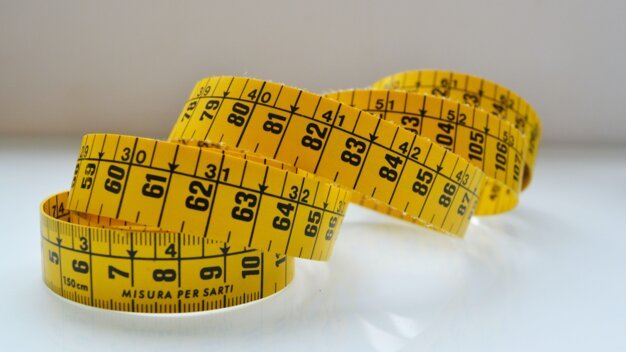
Precise measurement of the head circumference is the key to the right helmet size and therefore maximum protection on the slopes. With the following method, you can quickly and reliably determine it for your child at home.
To determine the correct ski helmet size for kids, you need
- A measuring tape or alternatively a piece of string and a ruler
- A little patience and a co-operative child
How to find your head circumference:
- Measure the head at the strongest point of the head. This is usually the point above the ears and eyebrows.
- Simply hold the measuring tape in place with one hand and wrap it horizontally around the head.
- Make sure that the measuring tape fits snugly but does not cut into the skin.
- Read off the circumference in centimetres and make a note of the result.
- Look in the table below or at the manufacturer's specifications and find the size you need for your child's ski helmet.
Kids ski helmets: Size chart according to age and head circumference
Important note: The values are guidelines. If in doubt, please refer to the manufacturer's (sometimes varying) size specifications when choosing a helmet.
| Age of the child | Head circumference in cm | Size |
|---|---|---|
| 0 to 1 year | 40–43 | XXS |
| 1 to 2 years | 44–47 | XS |
| 2 to 4 years | 48–51 | S |
| 4 to 6 years | 52–55 | M |
| 6 to 8 years | 56–59 | L |
| 8 to 13 years | 60–62 | XL |
Tips on the perfect fit for the kid’s ski helmet
The ski helmet should fit children snugly - but only so that it is not uncomfortable or painful for the little ones. The closed helmet must not wobble or slide sideways or backward during fitting. Here are our tips for testing them:
- Let your child wiggle their head with the chin strap open. If the helmet does not slip, it fits perfectly.
- To ensure that the helmet protects the entire head, including the forehead, it should rest about two finger widths above the eyebrows.
- Padded models adapt to the shape of the head over time and give way at pressure points. Therefore, when fitting a helmet, it is better to be a little too tight than too loose.
- Children often wear a thin cap under their helmet when skiing. So don’t forget to bring one to try it on!
Other factors when choosing ski helmets for children
A perfect ski helmet for your child should not only fit in size, but also impress with other important features. In addition to the right size, factors such as weight, material, adjustability, and age-appropriate functionality play a critical role in ensuring optimal protection and comfort on the slopes.
The weight of children's ski helmets
Size is not the only decisive factor when buying ski helmets for children. The weight of the helmet is also crucial. Why? In the event of a fall, the weight of the ski helmet puts additional strain on the child's neck muscles. The basic rule is:
- Modern models weigh between 300 and 500 grams, depending on size and material.
Lighter products should therefore be favoured, especially for smaller children.
Ski helmets for kids: materials and construction
Most ski helmets are using the in-mould technology, which makes them particularly light. This is ideal for very small children and beginners. Kids ski helmets in this category generally consist of:
- An outer hard shell made of ABS plastic for impact protection
- An inner layer of shock-absorbing EPS foam
- Soft padding for comfort and a customised fit
In contrast, ski helmets in the hardshell category are considered more robust, but are also somewhat heavier.
Adjustment systems and customisation options for children's ski helmets
High-quality ski helmets for children have:
- A dial system for easy size adjustment
- Removable or adjustable pads for fine tuning
- Easy-to-use fasteners on the chin strap, which are also easy to operate when wearing gloves
These features are particularly important as they enable precise adjustment and can grow with the child.
Tip: Removable and customisable pads are not only important for fine adjustments, but also increase hygiene. Together with the padding, the entire inner lining can often be removed and washed.
Special requirements for toddler ski helmets
Special toddler models are available for the very youngest children aged 1 to 3 years, which are tailored to the requirements of this age group. The following criteria apply when selecting a ski helmet for toddlers:
- Particularly lightweight design is easy on the still weak neck muscles
- Easy to put on and take off is important as toddlers are often impatient
- Soft, warm ear pads offer additional comfort and protection from the cold
- Very intuitive fasteners that are easy to operate even when wearing gloves
Ventilation of ski helmets for children
One aspect of ski helmets that often gets underestimated is ventilation – this applies to both adult and children's models. So when buying, make sure that there is an appropriate system for removing moist, warm air from breath and skin. It is at least as important that the ventilation systems of the goggles and helmet are compatible with each other. Otherwise the air will build up and the inside of the ski goggles may mist up.
Safety standards for ski helmets for kids
Many children's ski helmets are labelled with a safety certification. If you see the number 1077:2007 on the helmet or in the product description, you know that the helmet complies with the European standard for ski and snowboard helmets.
A distinction is also made between helmet classes A and B. For kids, we at INTERSPORT Rent recommend class A – a full-shell helmet. It covers a larger protection area than class B. In contrast to the so-called half-shell helmet, it covers the ears and temples.
There are also helmets with MIPS , a technology that helps to better absorb and distribute impact forces caused by a fall. We will be happy to advise you at one of our more than 800 INTERSPORT Rent shops.
Ski helmets for kids with visor or ski goggles?
Many parents ask themselves this question. The decision in favour of a children's ski helmet with a visor or a classic model with separate ski goggles is a question of personal preference and the area of use. The following overview provides some guidance:
Advantages of a visor ski helmet for children
- Wider field of vision than with classic ski goggles
- Sufficient space for prescription glasses
- No additional purchase of ski goggles necessary
- Fogs up less quickly in damp conditions
- Easy handling – no problems with slipping goggles
Disadvantages of a children's ski helmet with visor
- Often more sensitive surface than ski goggles (after removing the protective film)
- Often less UV protection than special sun ski goggles
- Less flexibility in changing light conditions (no option to change glasses)
For younger kids and beginners, a ski helmet with a visor is often the more practical solution, while advanced young skiers may prefer the flexibility of separate ski goggles. Visit our RENTertainers at one of our more than 800 INTERSPORT Rent shops worldwide. We will be happy to advise you on suitable products.
Check ski helmets for kids regularly
A ski helmet for children is not a purchase for eternity. Therefore, check it regularly for cracks, dents or signs of wear. After a heavy fall, the helmet should definitely be replaced, even if there is no visible damage - the protective effect may already be impaired. Bear in mind that the maximum service life is around 3-5 years, regardless of the condition.
At INTERSPORT Rent, you can rent a suitable ski helmet for your child every season – so you always have a wide selection of models in the perfect size without having to buy a new one every year. Depending on the shop, you can benefit from additional offers. Our experts regularly check all rental helmets for safety and will be happy to advise you personally on all winter sports-related topics!
Frequently asked questions about ski helmets for kids:
From what age does a child need a ski helmet?
As soon as your child is on skis, it should wear a helmet – regardless of whether it is only 2 or already 12 years old.
In some countries, wearing a ski helmet is even a legal requirement: In Austria and Italy, all children under the age of 15 must wear a helmet, in Germany there is no legal requirement, but a strong recommendation for all skiers. In France, there is also no obligation to wear a helmet, while in the USA and Great Britain the regulations vary depending on the state or ski resort.
Regardless of legal requirements, your child's safety should always come first!
Can my child wear a hat under their ski helmet?
Yes, but make sure that it is a very thin, flat hat that is specially designed to be worn under a helmet. Normal thick winter beanies impair the fit of the helmet and therefore the protective effect considerably.
How do I recognise that the helmet has become too small?
Children's ski helmets that have become too small are characterised by:
- Pressure marks and red spots on the forehead or sides
- Complaints from the child about headaches after wearing it
- Visible gaps between the helmet and ski goggles
- The helmet sits higher on the head than when purchased
What does a good ski helmet for children cost?
A high-quality ski helmet for children costs between €40 and €120, depending on the brand, equipment and features. Entry-level models with basic safety features are available from €40-60, while premium models with additional features such as improved ventilation, integrated visors or particularly lightweight materials range from €80-120. Remember that price does not necessarily correlate with safety - all helmets sold in the EU must fulfil the same safety standards. You can also rent ski helmets and accessories for the season from INTERSPORT Rent. An inexpensive alternative to buying, especially for fast-growing children.
Which ski helmet size for which age for kids?
When choosing the right ski helmet for children, it is less about age and more about the individual head circumference. There are of course guide values that can be used, but growth is usually so different that the actual age is of little help. Instead, use a tape measure and focus on the widest point. The head circumference you have now determined will serve as a guideline to help you find your way between the size charts of different manufacturers.
INTERSPORT Rent tip
The RENTertainer recommends
When trying on helmets, pay attention to the perfect fit first and not primarily to the look! Only when you have found suitable products from a particular brand should you focus on the design.
INTERSPORT Rent offers a practical solution for children who grow quickly: seasonal rental of children's helmets. This way, your child will have a perfectly fitting helmet including matching accessories every season without you having to buy a new one every year. Our experts will be happy to advise you at one of our 800+ locations and help you choose the perfect ski helmet for your child.
Find INTERSPORT Rent near you!
Related articles
You may also be interested in: