You're finally holding your new snowboard in your hands. The joy is great and you want to get on the mountain straight away. But before you get dressed up, you need to adjust your snowboard bindings. With the tips and tricks from the snowboard experts at INTERSPORT Rent, this is very easy.
Fitting and adjusting snowboard bindings: How it works
First things first: There is no right or wrong way to adjust snowboard bindings. A lot depends on the person, their physical characteristics and riding style to optimally fit and adjust the bindings. And this applies regardless of whether you are a freestyler in the park, ankle-deep in powder or on the slopes. What's more, the adjusted bindings should ideally also match the character of your board.
The most important thing: What is the stance and how do I adjust it?
Adjusting the snowboards bindings is the same for men and women. The only thing that matters is your intention with the board. Park, slope, powder – anything is possible. And the perfect mounting points as well as the right settings will help you. Here we go.
Adjusting the binding is a step-by-step process:
- Mounting the bindings on the snowboard.
- Goofy vs. regular
- Stance width
- Binding offset (stance setback)
- Binding angle
- Adapt the bindings to your boots and adjust it correctly.
But before we start with the fitting itself, we should talk about a term that you will come across more often in this article: Stance, which refers to your foot placement on the board. And for the next few steps, we'll be looking at the stance in various ways.
Tip: On new snowboards, the "reference stance" is usually indicated by a mark on the second and fourth screw hole. Manufacturers generally recommend this classic position for snowboard beginners and all those who enjoy riding on different terrains (all-mountain riders).
Switch, Goofy or Regular: What do these terms mean?
In the shop, our RENTertainers often ask you about Goofy or Regular at the beginning. They are not trying to test your Disney expertise. Both terms stand for orientations on the board. Or to put it simply: Which foot is in front when riding?
- Goofy: The right foot is in front.
The right binding is positioned at the front of the nose, the left one at the back of the tail. - Regular: The left foot is in front.
The left (front) binding goes on the nose side, the right (back) binding on the tail side.
Tip: If you don't know where you stand on your board, the famous "push test" can give you an idea. Have someone unexpectedly push you forward. The foot you step on first is most likely the one that will be at the front of the board later.
If you have a skateboard to hand, you can also simply stand on it and push for a few metres. Depending on which position you feel safer in, you should adjust your bindings accordingly.
There is also the term switch. Anyone who rides switch – regardless of whether regular or goofy – has their unfamiliar foot in front (so at that moment you are going "backwards" to the normal direction of travel).
The stance width: wide or narrow
As soon as you know which foot will be in front, we determine the stance width. The following rules apply:
- The stance is always measured from the centre of the front disc of your binding to the rear disc.
- In addition to your riding style, the length of your board is also decisive.
- A shoulder-width leg position is comfortable for most boarders, especially beginners.
- Advanced riders may also prefer a wider stance for more stability in the park.
- The exception, however, is a stance that is less than shoulder width. You can still see this from time to time in snowboard cross.
Binding position (stance setback): Offset measured from nose and tail
The offset determines how far you mount your binding forwards or backwards from the centre point. The position itself is determined by two aspects:
- Riding style
- Snowboard type
Let's take a look at your stance setback for different styles. Incidentally, the same rules apply for men and women when adjusting your snowboard bindings.
- Freestyle board: Centred (same distance between the respective binding and the nose and tail) The central alignment makes it easier to ride backwards – the best conditions for a visit to the park!
- Freeride board: Slight setback of 1 to 1.5 centimetres (place the binding slightly backwards from the centre of the board towards the tail). This position shifts the weight to the tail, changes the weight ratio and thus provides more lift in deep snow.
- All-mountain board: Same or similar position as the freeride board.
Would you like to know more about the different types of snowboard? Then read our guide about snowboards or our tips for buying your first snowboard!
How to adjusting the binding angle (stance angles)
We are now directly on the binding and on the disc. To determine the angle of your bindings on the snowboard, it is best to start with a neutral position, i.e. at 0 degrees. From there, turn slowly until you have found the right setting.
The degrees on the disc range from around minus 20 degrees to plus 20 degrees. You can therefore see exactly which position the binding is in.
Tip: As a beginner, it's best to stick with the neutral stance, which is ideal for forward riding.
Depending on your style, there are a few special features when setting the angles. If you have the time, try it out and experiment with the bindings on your snowboard. However, don't plunge into the most difficult terrain straight away after applying some changes.
The right binding angles for freestyle riding in the park
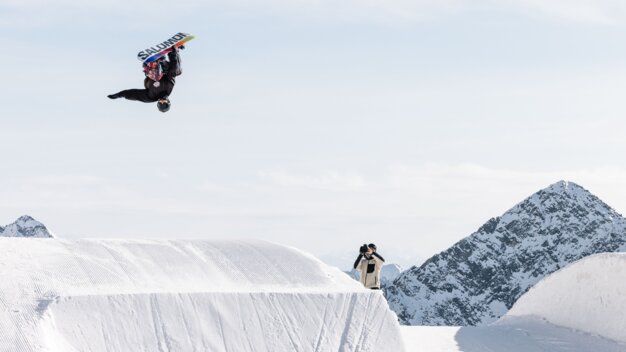
Most people believe in the duck stance of their freestyle bindings. This means that the front binding is set at a positive angle and the rear binding at a negative angle. The front angle is often slightly steeper than the rear angle, creating a V-position. This is perfect for riding backwards as well as for tricks and turns, as the weight is evenly distributed on the board.
The following binding angles should be selected for a freestyle setup:
- + 15 degrees at the front
- - 15 degrees at the rear
The right stance angles for freeriding:
As a freerider, you are well advised to use a slightly narrower stance. To do this, mount both bindings at a positive angle. This position allows you to exert better pressure on the edges during turns. In combination with a slight stance setback, this gives you the perfect setting for fantastic powder descents.
Guide values for the perfect binding angles for freeriding:
- maximum + 21 degrees at the front
- + 9 degrees at the rear
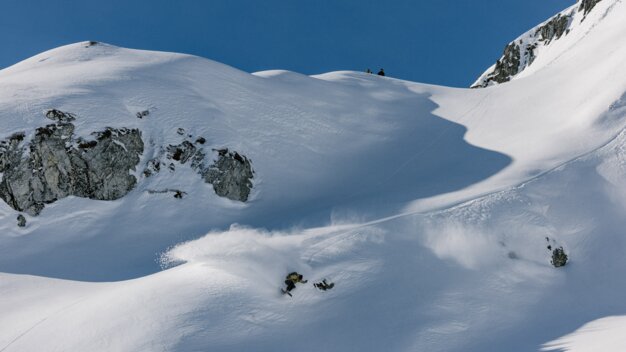
For all-mountain riders
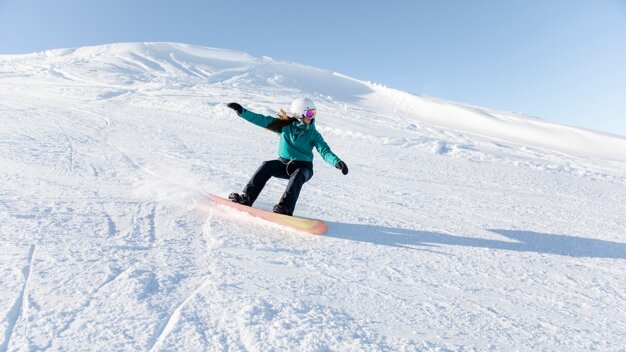
If you don't want to specialise in one riding style, a moderate duck stance (see above) with a slight setback is the right choice for you. This gives you good edge grip, high stability and sufficient flexibility for tricks and deep snow adventures.
These are the right binding angles for all-mountain boards:
- + 15 degrees at the front
- between - 9 and + 6 degrees at the rear
Once you have set the angles, place the binding back on the board. Screw them to the disc in the holes you have previously determined on the snowboard! Make sure that the binding is put down horizontally on the board!
Tip: Pack a small tool for adjusting the binding for your first attempts on the new board! That way you can make any necessary changes yourself on the mountain.
The finishing touches: Final adjustment of snowboard bindings with boots
Now all you have to do is adjust the binding to your boots. After that, you only have to hope that there is enough snow. The final step in adjusting your snowboard bindings involves fine-tuning the highback (the vertical plate of the binding that rests against the calf and supports the lower leg) and straps. This is where you decide on comfort, control and power transmission.
Adjust the highback correctly
The highback should be adjusted so that it lies flat against your boot and offers the desired forward lean. The steeper it is, the more directly your board reacts, especially when carving turns.
Step-by-step guide: Highback adjustment
- Place the boot in the binding: To do this, put on your boot and step into the binding. Then close the straps with little pressure.
- Centre the binding: The protrusion at the heel edge should be greater than that at the toe edge, approximately a 2:1 ratio.
- Align the highback: Check the position of the highback to make sure it is parallel to the heel edge of your snowboard. The side screws allow you to correct this.
- Set the forward lean: The next step is to set the forward lean or forward lean angle. Park skiers generally prefer a vertical position or a low forward lean. Freeriders and slope enthusiasts, on the other hand, favour a more pronounced forward lean. Depending on the brand, the adjustment mechanism is located directly on the highback and can be changed using a lever or screw. Optimum alignment is crucial for your grip and power transmission. For binding angles of more than +15 degrees, it makes sense to rotate the highback along the longitudinal axis.
The backplate is properly adjusted when it sits flat against the boot without leaving pressure points or too much play. Further fine tuning should be checked after a few descents.
Fix straps & laces for optimum comfort
In addition to the highback, the straps are also crucial when it comes to comfort and performance. Once you have put your snowboard boots on correctly, use our step-by-step guide:
- Positioning your boots: Again, the first step is to align your snowboard boots so that they are centred in the footbed.
- Adjust the toe strap: Make sure it is centered over the toes and that the front strap fits snugly over the toe of the boot. Depending on the binding model, there may also be dealer-specific differences. Tighten until there is no pressure and a slight pull forces the boot back into the binding.
- Ankle strap (instep strap): The upper buckle is fixed in the centre of the instep and should fit snugly without cutting off circulation. You should still have little room to move your foot without being able to lift it upwards.
- Alignment of the ratchet and strap length: When tightening, it is important that the ratchet is centred and in an easily accessible position. The length of the strap is also correct if you have room to tighten and widen it after a few clicks.
If you are unsure about the right settings for your snowboard, boots and bindings, you can also ask our RENTertainers for advice. They are the winter sports experts in the shops and are sometimes ski instructors or guides themselves. And if you need new boots, we can recommend our article on snowboard boots with useful information and tips in advance!
Frequently asked questions about adjusting snowboard bindings:
What angles are there when adjusting snowboard bindings?
Many bindings cover the range from -20 to +20 degrees. However, this varies depending on the manufacturer. Values of -15 to +30 degrees are also possible. The settings can be different depending on your riding style, personal preferences and the terrain.
While snowboarders who spend a lot of time in the park often favour a duck stance (positive front angle, negative rear angle), freeriders rely on positive binding angles at the front and rear.
How far apart should snowboard bindings be?
At the beginning, a shoulder-width leg position is usually chosen, as this offers good balance and control. However, the stance width can be adjusted depending on the riding style and terrain. Snowboarders who ride in the park, for example, prefer a wider stance in order to achieve better balance on rails.
Is it better if the nose of the snowboard is longer than the tail?
The stance setback depends on the riding style and snowboard type. While boards for powder riding usually have a slight offset to the tail and thus provide better flotation, the stance setback on a freestyle board is more central.
How do I find out whether I'm goofy or regular?
The most common method is the push test. Don't be alarmed if the salesperson or a friend asks you to turn round briefly. A small (unprepared) push is usually enough for you to take a step forwards. The foot you step on first is most likely the one that will be at the front of the board later: If you step on with your right foot first, you're goofy. On the other hand, if you step on with your left foot first, you are Regular.
INTERSPORT Rent Tip
The RENTertainer recommends
Have you adjusted your snowboard bindings and found the perfect stance? Congratulations! It's best to write down the angle settings and measurements right away! That way, you can quickly transfer your customised set-up back to the original if the binding needs to be removed during servicing.
Remember: Tighten all screws before you get on the snowboard and point your nose downhill. This is the only way to make sure that everything is in place when riding. Now you're ready for the slope, off-piste or freestyle tricks in the park.
Related articles
You may also be interested in: