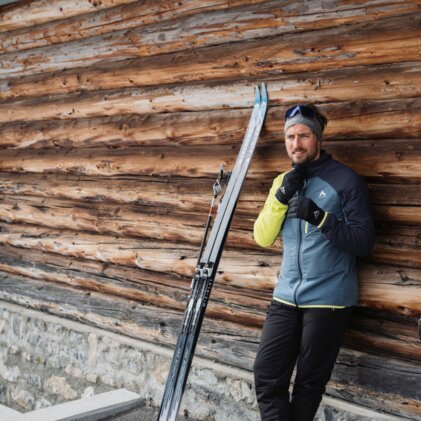
The right length of your cross-country poles can have a significant impact on your performance. This is because they provide you with the propulsion you need. If they are too short, you will run out of power more quickly because you won't get the necessary thrust on the trail. If they are too long, they can even be a nuisance.
So how to determine the cross-country ski pole length and are there differences depending on your skiing style? We have done some research for you and compiled the most important information about pole length, the right material and care.
The right size of cross-country poles
The length of the cross-country poles depends on the style you want to practise. Another important factor is your own height. The basic formula for classic cross-country skiing is that the right size is at shoulder height. For skating style, on the other hand, it can be a little longer. The guideline value here is between the chin and the tip of the nose.
How do I measure the correct length of cross-country poles (classic and skating)?
Are you a fan of numbers? Then we have two formulas for you that you can use to easily determine the right size of your poles.
Calculation basis for the size of cross-country poles:
| Style | Recommended pole length (formula) | Guideline |
|---|---|---|
| Classic | Body height in cm x (0.83-0.85) | Up to shoulder height |
| Skating | Body height in cm x (0.89-0.90) | Between chin and tip of nose |
If you are unsure about choosing the right length, our RENTertainers in a shop near you can help you at any time. We look forward to your visit.
Size chart: Which length of cross-country ski poles for which body size (skating and classic)?
| Body size in cm | Skating (factor 0.9) | Classic (factor 0.85) |
|---|---|---|
| 160 | 144 | 136 |
| 165 | 148,5 | 140,25 |
| 170 | 153 | 144,5 |
| 175 | 158,4 | 148,75 |
| 180 | 162 | 153 |
| 185 | 166,5 | 157,25 |
| 190 | 171 | 161,5 |
| 195 | 175,5 | 165,75 |
| 200 | 180 | 170 |
How to choose the right length of cross-country poles for children
There are a few things to bear in mind when choosing cross-country poles for children. As they are still growing, you should not buy poles that are too long "in stock". This can significantly flatten the learning curve and lead to the technique being learnt incorrectly. In addition, coordination, strength and balance are even more important for children than for adults.
The formula for calculating the correct length of cross-country poles for children:
- Classic = height × 0.85
- Skating = height × 0.90
Tip: The calculation basis is identical for children and adults. An alternative to the formula is the rule of thumb: with the classic technique, the pole reaches approximately to the shoulder or just under the armpit, with skating to between the chin and nose.
Size differences between beginners and professionals
In addition to the calculation formula for the optimum length of poles - whether classic or skating - there are also two differences between beginners and advanced athletes:
- Beginners: They often reach for slightly shorter poles. These are easier to coordinate and make learning easier.
- Advanced skiers: Longer poles guarantee a more powerful push when using the correct technique to make progress.
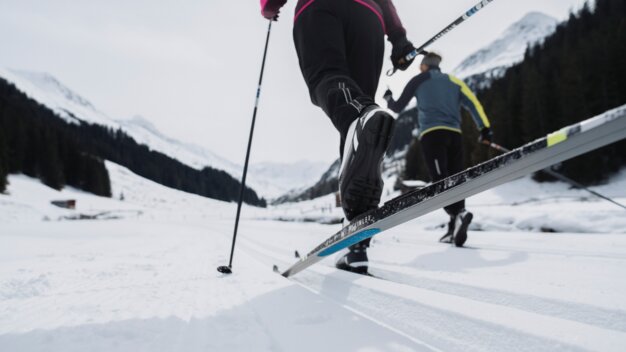
Tip: The calculation factors for both skiing styles are guidelines. Depending on your level and style, your personal value may differ slightly.
Cross-country poles made of carbon or aluminium: Which material is right for me?
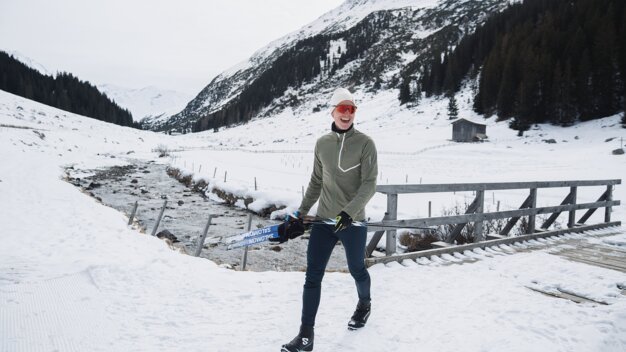
Cross-country poles are made from different materials and the various models can be categorised by their weight, robustness and price.
- Aluminium: These cross-country poles are beginner-friendly and attractively priced. Despite their higher weight, they are still comfortable to handle and absorb smaller impacts better than carbon fibre.
- Composite: This variant is a compromise solution made from several fibre materials. This is a multi-layer structure, the core of which is typically made of fibreglass. The material mix also contains carbon components, which results in lower weight.
- Carbon: Cross-country poles made from this material are impact-resistant and also extremely light. Their stiffness gives them a very high pressure load and enables direct power transmission. However, they are susceptible to scratches, which can lead to cracks in the longitudinal fibres. Of all the variants, carbon models cost the most.
Are there any other distinguishing features of cross-country poles?
Another criterion in the classification of cross-country poles is the strap. It is used to connect the pole to your hands. The following versions are available:
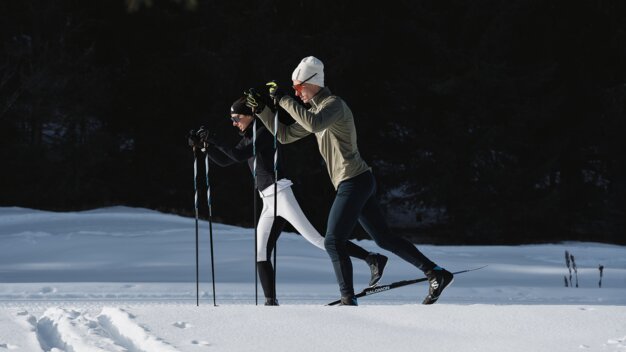
- Fixed loops: They are firmly attached to the handle. This type of strap should be flexibly adjustable so that you can optimally adapt it to your wrist. Padded inserts are the ultimate in comfort when cross-country skiing.
- Detachable straps: In this case, there is no permanent connection to the pole, but there is a fixed connection to your glove. Flexible adjustability and the right size are essential to avoid pressure points and ensure maximum comfort. To create a fixed connection with the cross-country pole, the strap is either clicked or pinned into place.
Either synthetic fibre or leather is used for the material of the straps for cross-country poles. While synthetic textiles are light and robust, leather straps are slightly heavier but offer a more pleasant feel.
Cross-country skiing technique: How do I hold and use cross-country poles?
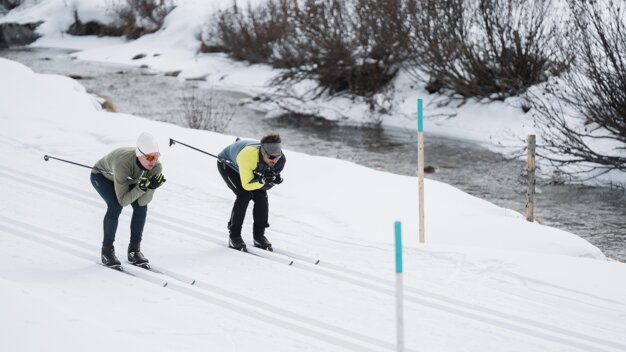
The diagonal stride is the classic technique, whereby you ski in two grooves on a groomed trail. The poles are used to push off in individual strokes. The cross-country skiing technique gets its name from the diagonal movement of the legs and arms.
When you push off with the left pole, the left leg is extended and at the same time the right leg is moving forwards. Now move your left leg forwards and stretch your right leg backwards. At the same time, the arms change position.
The double pole push is used in classic cross-country skiing when you want more speed. In this case, arm strength is required, as both poles are used simultaneously to increase speed. The legs are parallel and the knees are centred over the cross-country skis. The right length of cross-country poles is particularly important for this movement sequence. If they are too short, no thrust can be generated. Poles that are too long prevent you from performing the movement correctly.
Hit the trails with the right cross-country skiing accessories
Every outdoor adventure has its requirements for accessories. These can be new or different plates for cross-country poles, gloves or cleaning agents for functional clothing. In this context, it is important to familiarise yourself with the sport and the associated care of the products. This not only ensures that the fit and performance are maintained, but also that all items are long-lasting. Here you will find tips on how to care for your accessories properly:
- Clothing for cross-country skiing (jacket, gloves etc.)
- How to dry ski boots
- Fogged ski goggles
- Waxing cross-country skis
If you need a ski service for your cross-country skis in addition to the right cross-country poles, our RENTertainers look forward to your visit. They are the winter sports experts at INTERSPORT Rent and will be happy to advise you at one of our many locations.
Note: Due to the low speed and the associated reduced risk of injury, protectors are usually not worn when cross-country skiing. Yet, if you are still unsure, you can rely on so-called soft protectors. They absorb impact forces and allow full freedom of movement without being noticeably bulky.
Frequently asked questions about the right length of cross-country poles
What is the difference between cross-country and alpine poles?
One of the main differences is the length. Cross-country poles are significantly longer than alpine ones, as they are actively used for moving forwards. They are also made from particularly stiff materials such as carbon fibre in order to transfer power as effectively as possible. In terms of their construction, they are also narrower and thinner and have been developed to withstand less lateral load but greater pressure.
How long are skating poles?
The pole length for cross-country skiing varies depending on the style. While in classical style the height of the shoulders is generally used, in skating the area from the chin to the mouth and sometimes even to the tip of the nose is the reference. The rule of thumb for the correct length of cross-country skating poles is: body height x 0.90. Depending on ability, this factor can be smaller or larger.
When do ski poles need to be replaced?
Ski poles need to be replaced if you are still in the growth phase and the pole length no longer matches the calculated value. However, material damage can also be the reason for a replacement, as there is a risk of the pole breaking if there is a crack in the carbon. Another cause can be material fatigue, which may occur even though there is no external damage. Depending on the intensity of use and age, a service life of 8 to 10 years is assumed.
How is pole length measured?
The pole length for cross-country skiing is usually measured from the lower tip to the upper edge of the grip. However, some brands only state the length up to the lower edge or the centre of the grip. So it's best to take a look at the manufacturer's specifications to be on the safe side.
INTERSPORT Rent tip
The RENTertainer recommends
Don't let a lack of experience or equipment put you off cross-country skiing! At INTERSPORT Rent you can easily rent equipment for the cross-country ski trails. The experts will be on hand with help and advice and give you helpful tips for your first time on cross-country skis. You will also receive useful tips on the right cross-country ski boots and compatible binding systems.
Related articles
You may also be interested in: