Tight snowboard boots can ruin even the best day on and off the slopes. But this can be avoided simply by using the right technique when putting them on. Many problems aren’t caused by ill-fitting boots, but by incorrect lacing or an awkward foot position when stepping in. With the necessary know-how and a bit of practice, your boots will fit perfectly from the first run to the last.
Because putting on snowboard boots correctly means: the right preparation, lacing the inner and outer boots correctly, and knowing what matters when it comes to fit and the lacing system. Boot size, socks and the fastening system also play a key role. The experts at INTERSPORT Rent and Salomon have put together some practical tips for you.
Step-by-step guide: How do I put on my snowboard boots correctly?
The correct way to put on your snowboard boots depends largely on the lacing system of your boots. But whether it's BOA, speed lacing, or the classic system, the following basic steps apply to all sof them nd will ensure that your boots fit perfectly all day long.:
1. Preparation:
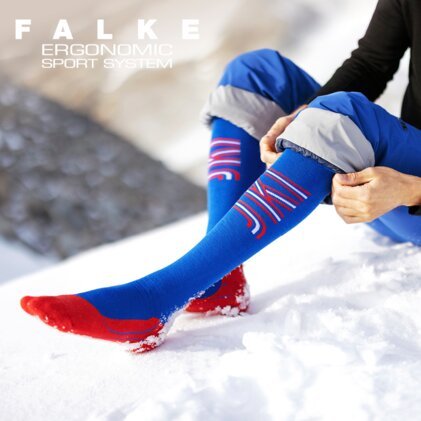
- Choose a suitable pair of snowboard socks
- Put them on so that all the padding is in the right place and there are no creases.
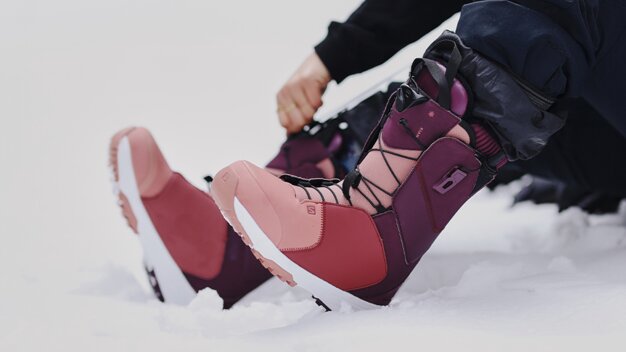
- Loosen the lacing systems on the outer and inner boots.
- Pull the tongue forward so that you have enough room to slip your foot into the boot.
2. Getting in:
- Step into your snowboard boots.
- Make sure your heels are in the correct position.
- To do this, tap your heels lightly on the floor so that they slide back as far as possible.
- Then check that the inner boot fits snugly against your shin.
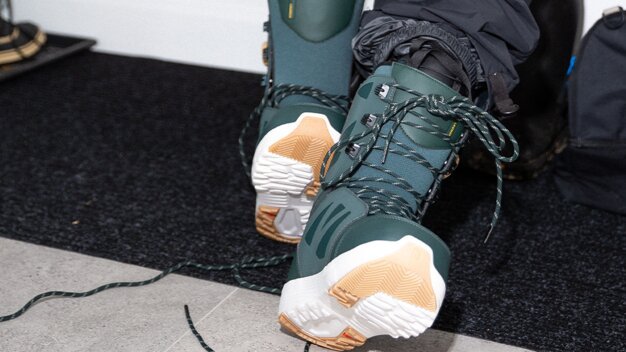
3. Lacing the inner boot:
- Tighten the laces so that pressure is evenly distributed throughout the lacing system. This will help prevent pinching.
- Make sure the boots are snug but not too tight.
- Bend your ankles and tighten the laces slightly.
- After lacing the inner boot, tuck the bow or cord neatly to the side of the inner boot.
4. Lacing the outer boot:
- Tighten the outer boot accordingly, depending on the attachment system.
- Make sure the tongue and sides of your snowboard boots fit snugly and that there are no creases.
INTERSPORT Rent tip: A perfectly fitting boot will only perform to its full potential if the binding is right. Everything you need to know can be found in our article on How to adjust your snowboard bindings correctly.

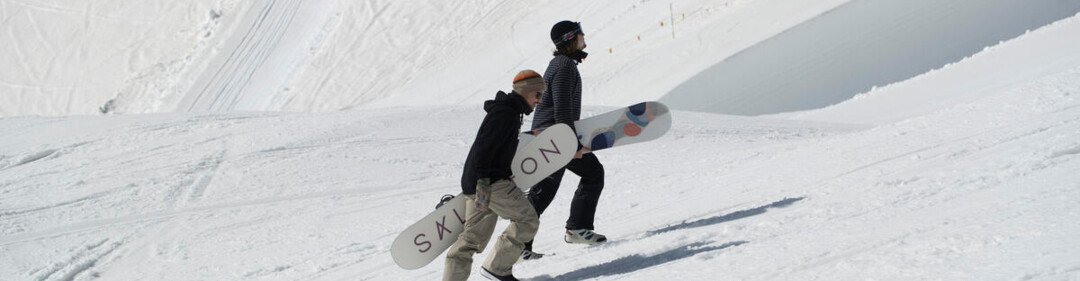
The correct stance for beginners
But even a perfectly laced boot will only perform at its best if your foot is positioned correctly on the board. A correct foot position not only helps with safe riding but can also reduce pressure points in the snowboard boots. It is significantly influenced by the placement of the binding, taking into account the following aspects:
- Stance width
- Binding setback
- Highback
- Binding angle
For beginners, a neutral stance with feet shoulder-width apart is the most common choice. In addition, the factors listed above will help you further customise your board to alter its handling characteristics. The winter sports experts at INTERSPORT Rent will be happy to help you determine which settings are best suited to you and your board in-store.
How do I know if my snowboard boots fit properly?
How tight should they actually be? When you buy a new pair of snowboard boots to go with your snowboard and bindings, they should fit fairly snugly (but not so tightly that they cause pain). The reason for this is that most models stretch a little at first. So if you choose boots that feel a little loose at first, they may end up being too big for you after your first few runs.
For a good fit, your toes should just touch the front of the liner, but you should still be able to move them freely.
When you bend your knees, your heel shouldn't slide around inside the boot. If this happens to you often, a boot with a heel strap may be the answer. This will prevent your foot from lifting up inside the boot.
The three most important factors for snowboard boots that fit really well are:
- The width of the boots
- The height in the toe area
- The heel area
Our tip: The surest way to achieve the perfect fit is with custom-made snowboard boots. Simply have your feet measured at your nearest shop and have them tailored precisely to your individual shape!
What fastening systems are available for snowboarding?
When buying snowboard boots, you can usually choose between three different lacing systems. Each has its pros and cons. Your choice will ultimately depend on how much comfort, precision, and speed you need when applying them.
Traditional lacing or “standard lacing”
The classic option among fastening systems: With traditional lacing, you can adjust each part of the boot individually and precisely regulate the pressure. This is an advantage that more modern systems do not offer.
- Good, secure fit
- Can be easily tightened or loosened at any point
- Broken laces can be replaced at low cost
- May come undone during the day
- Difficult to tie when wearing gloves
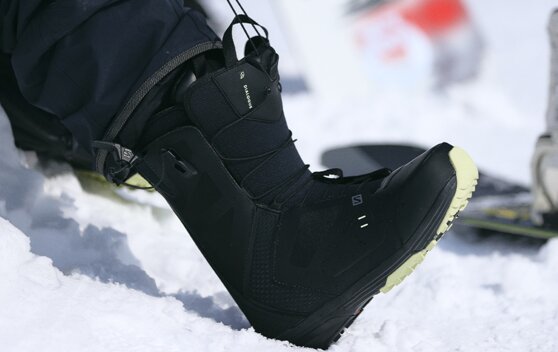
Quick-lacing or speed-lacing systems (e.g. DIALOGUE boots by Salomon)
Quick, convenient and easy to use even with gloves on: Speed lacing systems are particularly popular with riders who don’t want to waste time between runs. One pull is all it takes – and the boot fits.
- Quick to put on and take off
- Individually adjustable
- Firm, secure fit
- Easy to operate with gloves on
- Difficult to repair
BOA® lacing (e.g. LAUNCH BOA® SJ BOA® boots by Salomon)
The BOA® system is considered the most precise of the three options. A dial allows you to adjust the fit with millimetre precision – evenly across the entire boot. Particularly handy: you can make quick and easy adjustments even on the slopes.
- Quick to put on and take off
- Very easy to adjust
- Easy to adjust even when wearing gloves
- Precise fine-tuning
- Even fit across the entire boot
Not sure which system is right for you? At INTERSPORT Rent, you can rent a variety of boots with different lacing systems and test them on the slopes to find out what feels best for you.
4 tips to avoid pressure points when putting on snowboard boots
When it comes to snowboard boots, fit is everything. Pressure points or other problem areas can significantly reduce your enjoyment of winter sports. Our RENTertainers have put together a few tips to help you avoid pressure points:
- Tip 1: Choose the right snowboard socks. Use special socks made from functional natural and synthetic fibres such as merino or polyester. These are thin, breathable and usually seamless. Models made from materials that are too thick or unsuitable can cause creases and thus pressure points. Breathability is also compromised, which means your feet can stay wet and cold.
- Tip 2: Lace your boots evenly. It is important to lace your boots evenly from top to bottom. If they are too tightly in certain areas it can cause localised pressure points and affect your performance while riding.
- Tip 3: Position your heel correctly. Once you’re standing with your foot in the snowboard boot, tap your heel lightly on the ground so that you slide all the way back. This prevents extra pressure building up in the toe area. When stepping into the binding, also make sure you brush the snow off the bottom of your snowboard boots. Otherwise, snow sticking to the sole can prevent the boot from sitting properly in the binding. This is not only uncomfortable but can also impair performance.
- Tip 4: Don’t tighten the straps too much. Many snowboarders tighten the bindings too much. If the straps are pulled too tight, this can affect the blood supply to the lower limbs. The result: cold feet, pressure points and tired legs.
Frequently asked questions about putting on snowboard boots:
How far should snowboard boots extend beyond the binding?
A slight overhang on the snowboard boots is fine. However, they shouldn’t protrude by more than 2 cm. If the boots protrude any further, there’s a risk that they will touch the snow when turning, preventing the edge from gripping properly.
How tight should snowboard boots be?
First of all, your snowboard boots should fit snugly. This is because they soften as they are warmed by your body heat and as the material moves. Otherwise, you may find that after a few rides on the slopes or in the park, your performance starts to drop. The power of your movements will not be transferred to the board as effectively.
How do you fasten snowboard boots?
Depending on the manufacturer and model, snowboard boots come with a variety of fastening systems. However, when lacing the inner boot, make sure your foot is positioned correctly in the back and that the boot is fastened with even, but not excessive, pressure. The liner should provide a comfortable, secure fit. The outer closure – whether BOA, traditional lacing, or other quick release - should be tight as if you were already on the slopes.
Are snowboard boots large or small?
Just like with trainers, there are differences in the fit of snowboard boots. These can vary depending on the manufacturer and model. To find the perfect one, there’s no getting round trying them on in-store. At INTERSPORT Rent, you can also rent the boots and test them out for a whole day. What’s more, there’s also the option of customising them to suit your individual needs with insoles, for example.
What should you do if your heel slips in your snowboard boots?
If your heel slips in your snowboard boots, it is usually due to poor lacing. You should check that the liner and laces are tightened sufficiently and, above all, evenly. This will generally keep your heel in place. In addition, thinner snowboard socks, a different fabric blend, or special heel pads can improve support. If the problem persists, it may be a size or overall fit issue. In this case, it is worth having the boots professionally fitted.
INTERSPORT Rent Tip
The RENTertainer recommends
You now know how to put your boots on properly, but would you still like to try out a new lacing system? Or perhaps you’re looking for different bindings or a new snowboard?
At INTERSPORT Rent, you’ll find a wide range of snowboard equipment from leading brands available to rent. Our RENTertainers on site will be happy to help you find the boots that suit your needs. What’s more, our experts are the right people to ask if you have any questions about lacing!
Related articles
You may also be interested in: